
Buying a home is the biggest financial decision most people make in their lifetime. Yet most buyers walk into a bank without knowing exactly how much their monthly payment will be, how much total interest they will pay, or how different loan terms affect their finances. This lack of knowledge costs people thousands of dollars over the life of their loan.
The free Mortgage Calculator on HanCalc.com changes that. It gives you an instant, accurate breakdown of your monthly payment, total interest cost, and overall repayment amount — before you even speak to a lender. This guide explains everything you need to know: what a mortgage is, how the calculator works, what affects your payment, and how to make smarter home loan decisions.
What Is a Mortgage?
A mortgage is a loan you take from a bank or lender to buy a home or property. You borrow a large sum of money and agree to repay it over a fixed period — usually 15, 20, or 30 years — with interest. The property itself acts as collateral, which means the lender can take it back if you fail to make payments.
Every mortgage payment you make covers two things:
- Principal — the portion that reduces your actual loan balance
- Interest — the fee the lender charges you for borrowing the money
In the early years of your loan, most of your payment goes toward interest. Over time, more of it goes toward the principal. This process is called amortization.
For official consumer guidance on mortgages and home loans, the Consumer Financial Protection Bureau (CFPB) provides detailed educational resources.
Key Mortgage Terms You Need to Know
Before you use the mortgage calculator, understand these important terms:
| Term | What It Means |
| Principal | The original loan amount you borrow from the lender |
| Interest Rate | The annual percentage the lender charges on your loan balance |
| Loan Term | The number of years you have to repay the mortgage (e.g., 15 or 30 years) |
| Monthly Payment | The fixed amount you pay every month, covering principal and interest |
| Down Payment | The upfront amount you pay from your own money before the loan begins |
| Amortization | The schedule of how your loan balance reduces over time with each payment |
| LTV Ratio | Loan-to-Value ratio: how much you borrow compared to the home’s total value |
The Mortgage Payment Formula Explained
Lenders use a standard formula to calculate your fixed monthly mortgage payment. You do not need to solve this manually — HanCalc does it for you — but understanding the formula helps you make sense of your results.
M = P x [r(1+r)^n] / [(1+r)^n – 1]
Where:
- M = Monthly payment
- P = Principal loan amount (total amount borrowed)
- r = Monthly interest rate (annual rate divided by 12)
- n = Total number of payments (loan term in years multiplied by 12)
Example: You borrow $250,000 at a 6% annual interest rate for 30 years.
- r = 6% / 12 = 0.5% = 0.005
- n = 30 x 12 = 360 payments
- M = 250,000 x [0.005(1.005)^360] / [(1.005)^360 – 1]
- M = approximately $1,499 per monthOver 30 years, you pay a total of $539,640 — meaning $289,640 goes to interest alone. This is exactly why using a mortgage calculator before committing to a loan is so important.
How to Use the HanCalc Mortgage Calculator
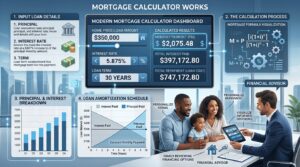
You get your complete mortgage breakdown in under one minute. Follow these simple steps:
- Go to HanCalc.com and open the Mortgage Calculator.
- Enter the home price or total loan amount.
- Enter your down payment amount (if any).
- Enter the annual interest rate your lender offered.
- Select your loan term (10, 15, 20, or 30 years).
- Click Calculate.
- Instantly see your monthly payment, total interest paid, and total repayment amount.
No registration. No fees. Works on all devices including smartphones, tablets, and laptops.
How Loan Term Affects Your Monthly Payment and Total Interest
Choosing a shorter or longer loan term dramatically changes how much you pay. Here is a side-by-side comparison for a $200,000 loan at 6% interest:
| Loan Term | Monthly Payment | Total Paid | Total Interest |
| 10 Years | $2,220 | $266,400 | $66,400 |
| 15 Years | $1,688 | $303,840 | $103,840 |
| 20 Years | $1,432 | $343,680 | $143,680 |
| 30 Years | $1,199 | $431,640 | $231,640 |
The difference is striking. Choosing a 10-year term over a 30-year term saves you $165,240 in interest — but your monthly payment is nearly double. Use the HanCalc Mortgage Calculator to find the right balance for your budget.
5 Factors That Affect Your Mortgage Payment
Your monthly payment does not depend on just one number. These five factors work together to determine what you pay:
1. Loan Amount (Principal)
The more you borrow, the higher your payment. A larger down payment reduces the loan amount and lowers your monthly cost. Most lenders recommend a down payment of at least 20% to avoid extra insurance fees.
2. Interest Rate
Even a small change in interest rate creates a big difference over 30 years. A 1% rate increase on a $300,000 loan adds approximately $170 to your monthly payment and over $60,000 to your total repayment. Always compare rates from multiple lenders before deciding.
3. Loan Term
A longer loan term means lower monthly payments but significantly more total interest paid. A shorter term means higher monthly payments but much less interest overall. The HanCalc Mortgage Calculator lets you compare different terms side by side instantly.
4. Credit Score
Lenders offer better interest rates to borrowers with higher credit scores. A credit score above 750 typically qualifies you for the lowest available rates. A lower score may result in a higher rate, which increases both your monthly payment and total cost.
5. Property Taxes and Insurance
Your actual monthly housing cost includes more than just principal and interest. Property taxes, homeowner’s insurance, and sometimes HOA fees add to your total monthly obligation. Factor these in when budgeting for your home purchase.
Smart Tips to Reduce Your Mortgage Cost
Use these strategies to pay less interest and own your home faster:
- Make one extra payment per year. This single step can cut 4 to 6 years off a 30-year mortgage and save tens of thousands in interest.
- Round up your monthly payment. Paying $1,550 instead of $1,499 every month reduces your principal faster and shortens your loan term.
- Refinance when rates drop. If interest rates fall significantly after you take your loan, refinancing can lower your payment and save you thousands.
- Make a larger down payment. Every extra dollar you put down upfront reduces your loan balance and saves you compounding interest over the entire term.
- Choose a 15-year term if you can afford it. You build equity faster, pay far less interest, and own your home outright in half the time.
Fixed-Rate vs. Adjustable-Rate Mortgage: Which Is Better?
When you apply for a mortgage, your lender offers two main types of interest rates. Understanding the difference helps you make a smarter choice.
Fixed-Rate Mortgage
Your interest rate stays the same for the entire loan term. Your monthly payment never changes, which makes budgeting easy and predictable. Most homebuyers prefer fixed-rate mortgages because they protect against rising interest rates.
Adjustable-Rate Mortgage (ARM)
Your interest rate starts low but changes periodically based on market conditions — usually after an initial fixed period of 3, 5, or 7 years. ARMs can save you money if you plan to sell or refinance before the rate adjusts, but they carry the risk of significantly higher payments later.
For most buyers who plan to stay in their home long term, a fixed-rate mortgage is the safer and more predictable option.
Frequently Asked Questions About Mortgage Calculators
How much mortgage can I afford?
A common rule is that your total monthly housing cost should not exceed 28% of your gross monthly income. For example, if you earn $5,000 per month, aim to keep your mortgage payment at or below $1,400. Use the HanCalc Mortgage Calculator to test different loan amounts and find what fits your budget comfortably.
What is a good interest rate for a mortgage?
A good mortgage rate depends on current market conditions, your credit score, and the loan term. Generally, a rate within 0.5% of the national average is considered competitive. Always compare offers from at least three lenders before choosing.
Does a higher down payment lower my monthly payment?
Yes. A higher down payment reduces your loan principal, which directly lowers your monthly payment and total interest paid. It can also help you avoid private mortgage insurance (PMI), which lenders often require when your down payment is less than 20%.
Can I pay off my mortgage early?
Yes, and doing so saves you a significant amount in interest. Check with your lender for any prepayment penalties before making extra payments. Most modern mortgages allow early payoff without fees. Even small additional monthly payments accelerate your payoff date considerably.
Conclusion: Know Your Numbers Before You Buy
A home is one of the most important purchases of your life. Walking in without understanding your mortgage payment, total interest cost, and loan options puts you at a financial disadvantage. Knowledge gives you power at the negotiating table and confidence in your decision.
The free Mortgage Calculator on HanCalc.com gives you complete clarity in seconds. Test different loan amounts, interest rates, and terms to find the combination that works best for your budget and your goals.
Calculate your mortgage payment now at HanCalc.com — and take the first step toward owning your home with confidence.